An AI YouTube script writer can speed up outlining and drafting, but it cannot decide what your audience genuinely needs or supply experience you do not have. The useful workflow is simple: give the model a specific brief, review the structure, add first-hand evidence, read it aloud and use retention data to improve the next script.
What an AI script writer should produce
- A clear promise: one viewer problem and one outcome.
- A concise opening: explain why the viewer should continue without delaying the answer.
- A logical structure: arrange claims, demonstrations and examples in a useful order.
- Production notes: mark screen recordings, B-roll, citations and visual proof.
- A relevant next step: invite the viewer to continue only when it fits the topic.
There is no universal hook length, script length or retention formula. The right structure depends on format, audience and the difficulty of the subject.
A practical AI-assisted scripting workflow
- Write a brief with the audience, problem, desired outcome, format, tone and facts that must be included.
- Ask for three outline options before requesting a complete draft.
- Choose the strongest outline and add your own example, demonstration or data source to each major section.
- Generate one section at a time when the topic is technical or evidence-heavy.
- Fact-check names, numbers, product claims and quotations against primary sources.
- Read the script aloud and remove formal phrasing, repeated ideas and transitions you would never say naturally.
- Mark every visual change in the script so recording and editing are planned together.
- After publishing, map retention drops to the matching script sections and record what you will change next time.
Product evidence: the current YourAI Studio interface
We reviewed the public YourAI Studio interface on September 1, 2026. Its script preview separates the producer’s vision, opening, three-act structure and teleprompter-ready output. That structure can help organize a draft, but the example text is interface demonstration content and is not proof of improved retention.
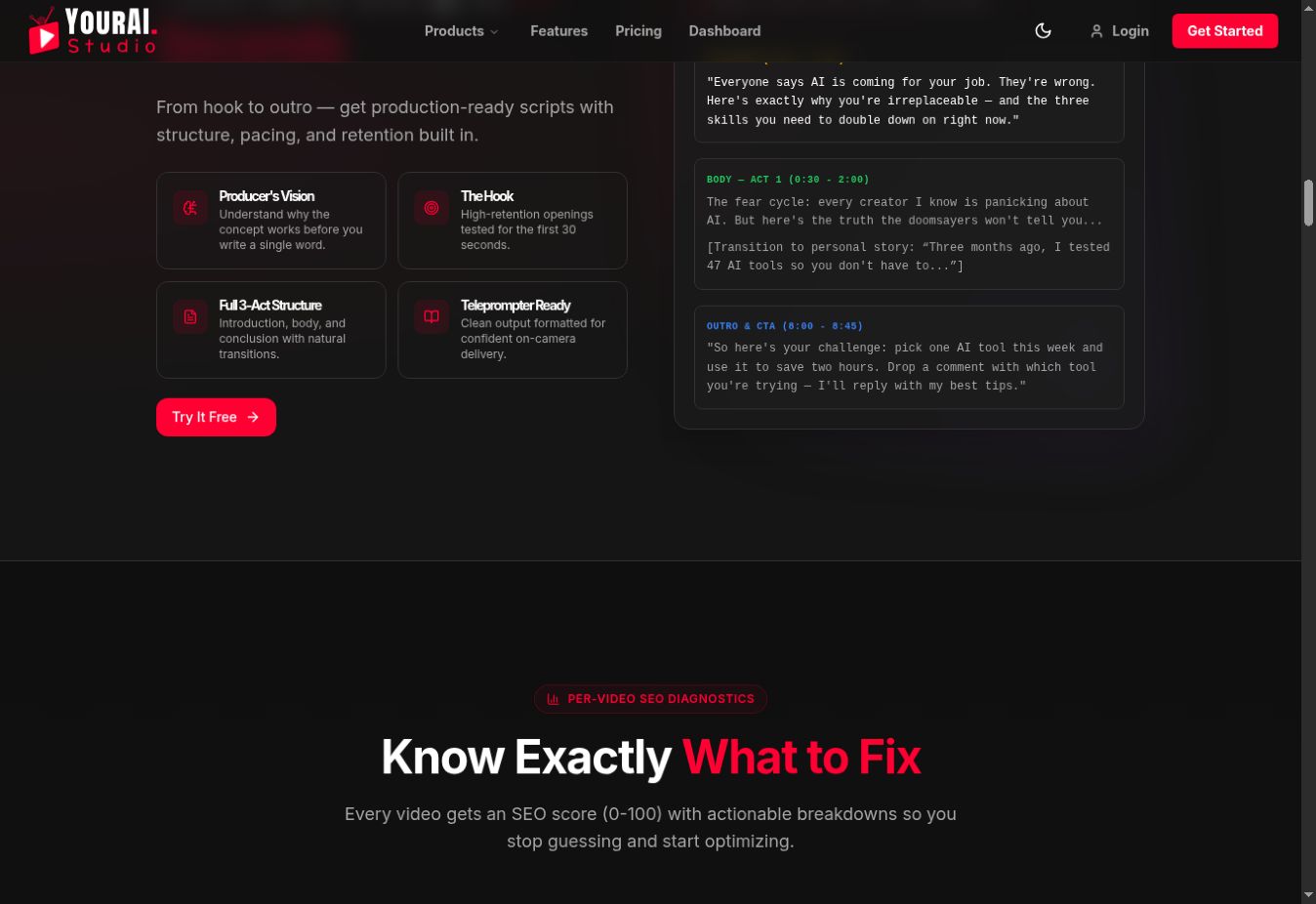
Try the YourAI Studio script workflow and judge it on the quality of the editable draft, not on a promise to automate creativity.
Prompt template
Create three YouTube video outlines for [audience] who need to [solve problem]. The video should help them [specific outcome]. Use a [format] structure and a [tone] voice. Include where I should add a demonstration, a primary source and a personal example. Do not invent statistics, quotations or customer results. Mark uncertain claims for verification.
How to measure whether the workflow helps
| Measure | How to use it |
|---|---|
| Drafting time | Compare similar video formats, not unrelated topics. |
| Revision count | Track how many substantial rewrites the AI draft needs. |
| First 30-second retention | Check whether the opening delivers the stated promise. |
| Average view duration | Use it with the retention graph, not as a standalone score. |
| Factual corrections | Count errors caught before publication. |
Common mistakes
- Publishing an AI draft without fact-checking or adding personal examples.
- Using a dramatic opening that promises something the video does not deliver.
- Repeating the target phrase until spoken language sounds unnatural.
- Copying a generic “viral” structure into every format.
- Letting the model invent evidence, users or results.
Frequently asked questions
Can an AI script writer guarantee better retention?
No. It can help organize a draft, but retention depends on topic fit, delivery, editing, credibility and whether the video satisfies the promise.
Should AI publish the final version automatically?
No. Use AI for outlining, drafting and comparison, then verify facts and approve the final script yourself.
Which part should I write myself?
Your experience, opinion, demonstrations, product judgments and final wording should remain yours. Those are the parts that make the script difficult to copy.